
Prepare for interviews
Prepare for this conversation.Not for interviews in general.
Generic interview advice is easy to find and nearly useless the night before. What you need is narrower: what this employer is likely to ask, why they are asking it, and which part of your own record answers it. iapplyai.app already holds all three, because it wrote the application.
The brief
What is in it.
One document per application, built from that application.
- The role and the company
- What is publicly known and relevant, not a company profile.
- Likely questions
- What this posting is going to probe, drawn from the description and your gaps.
- Why each one is asked
- The intent behind the question, so you answer the real thing.
- Evidence to use
- The story from your own record that answers it best.
- Gaps to defend
- The weak parts of your case, named before somebody else names them.
- Questions to ask
- Grounded in this role rather than the usual three.
The brief
Built from what you sent
The brief starts from the application itself: the posting, the resume you tailored, the letter you approved and the answers you gave. That continuity is the point. You are preparing to defend the version of yourself the employer actually read.
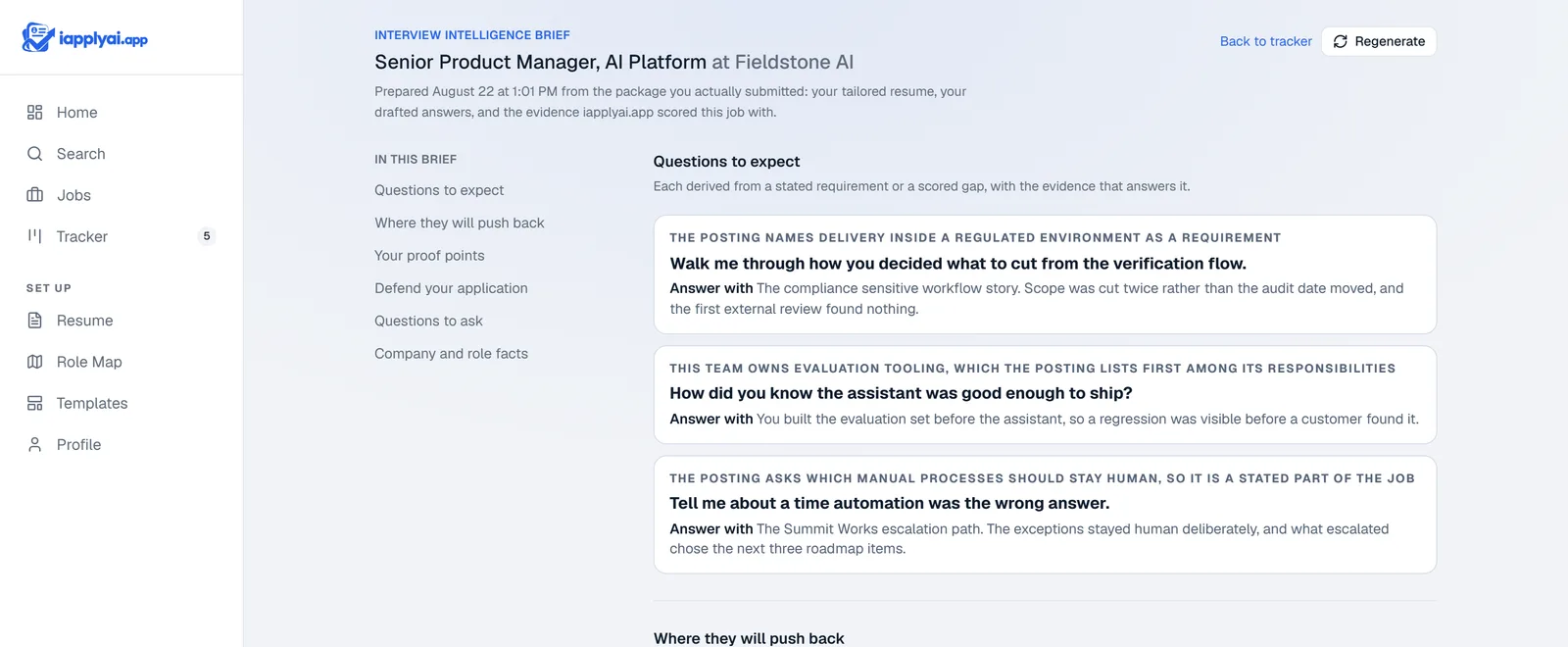
Questions
Likely questions, and why each one
iapplyai.app works out what this role is probably going to probe, and says why. A question you understand the intent of is one you can answer on your own terms rather than reciting at.
Evidence
The story to reach for
Each question is paired with the evidence from your own record that answers it best. No new claims, no invented outcomes. Things you have already said you did.
Gaps
What to have an answer ready for
The gaps the match found do not disappear because you got the interview. iapplyai.app names them again here, so the weakest part of your case is something you have thought about rather than something you meet for the first time in the room.
Your turn
Questions worth asking them
The brief ends with questions grounded in the specific role and company rather than the usual three. An interview is a conversation and the second half of it is yours.
Your experience carries all the way through.
From your first resume upload to the last question you ask them.